
QC Verification Task Addressed in This Article
Seeing QC photos before buying shoes doesn't automatically prove they fit, that materials are reliable, or that there are no hidden issues. The truly useful way to verify is to first confirm that the photos correspond to the correct product, then record size, color, upper, branding, stitching, toe box, outsole, and visible flaws item by item, and finally decide whether to proceed with the order, request additional photos, or pause the process.
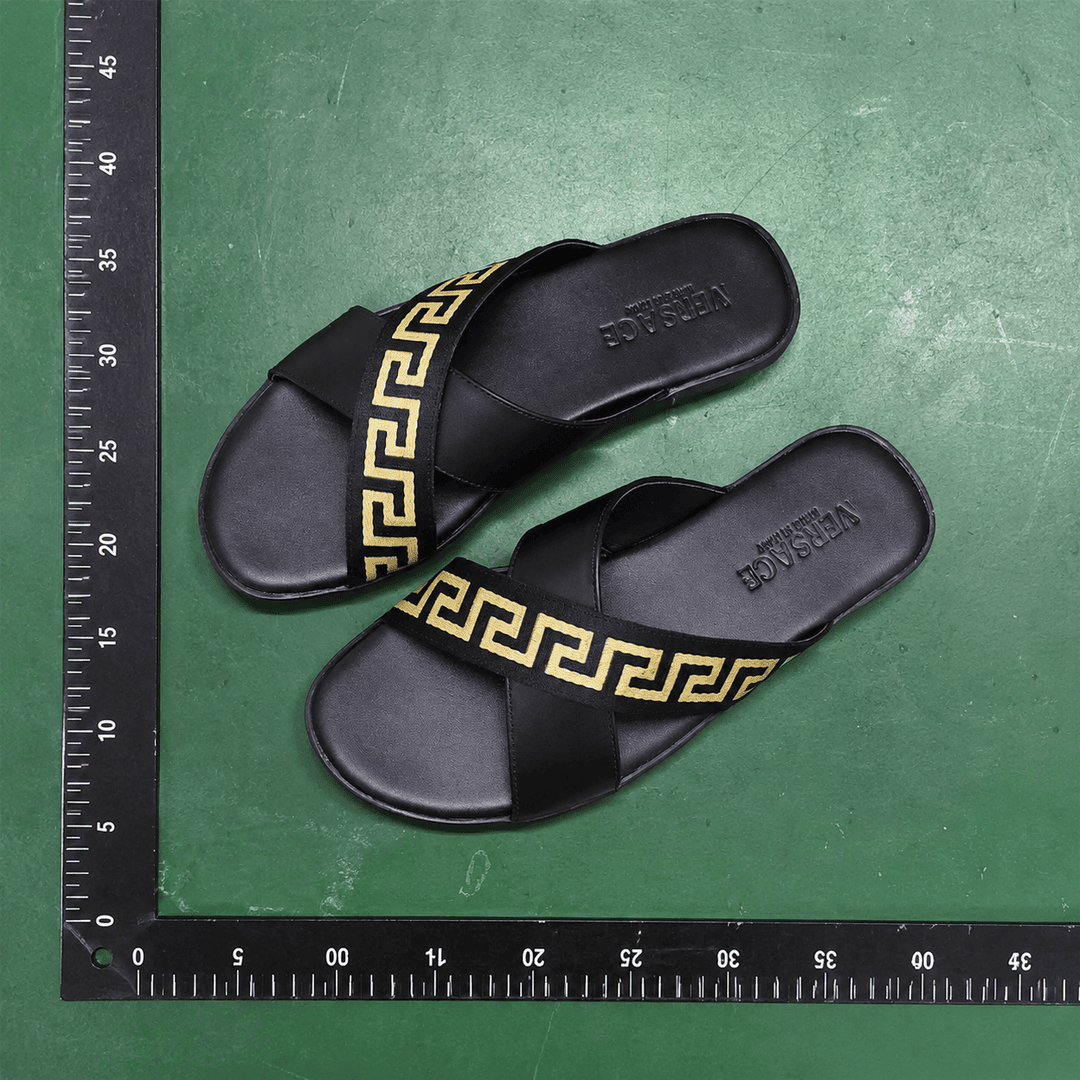
There's a correspondence issue that must be addressed first in this verifiable photo record: the page source of the specified image gallery shows Versace black slides, while the article topic is Kenzo shoes. Since the upper structure, logo placement, sole pattern, and sizing rules of different products cannot be substituted for one another, the checklist below can be used for pre-purchase verification of Kenzo products, but this Versace image cannot be treated as QC evidence for Kenzo. 🧭
Confirm Shoe Model, Color, Size, and Product Link on the fashion-reps Product Page
The first step should start from the specific product detail page on fashion-reps, not from the homepage, brand page, category page, or search results. After entering the page, verify the following:
- Does the product name clearly include Kenzo and the specific shoe model name?
- Is the color consistent with the version you intend to buy? Don't rely solely on thumbnails.
- Does the size range listed on the page cover the size you plan to purchase?
- Does the product detail page have a clear purchase entry and corresponding product information?
- Does the QC entry on the page belong to the current product, not a different shoe in the related recommendations?
If the product title, color, size, or link doesn't match, pause first. Pay special attention to cases where the page title and image record are inconsistent. The source summary of the specified image shows Versace black slides, and the page also includes information such as Versace, black slides, webbing and leather upper, and rubber outsole. Therefore, it cannot be rewritten as actual observations of a Kenzo upper or Kenzo outsole.
Open the QC Photos for That Product via View QC Photos
After confirming the product detail page, use the entry named View QC Photos on the page to enter the current product's QC gallery. Don't guess the QC URL based on experience, and don't directly use images from other products.
After entering the gallery, first confirm whether the product in the images matches the detail page:
- Is the shoe silhouette consistent?
- Are the color and colorway consistent?
- Is the upper structure consistent?
- Are the sole shape and tread pattern consistent?
- Does the image clearly come from another product or another size?
The specified image is inserted once as a sample for product correspondence verification, as originally recorded:

This image's public source record corresponds to Versace black slides and should not be used to prove the size, stitching, print, hardware, or outsole condition of Kenzo shoes. It can help editors identify product evidence mismatches, but it cannot replace the Kenzo product's own QC original images. 🔎
Record Visible Information by Comparing Size Chart, In-Shoe Markings, and Left/Right Shoe Specifications
Size verification must be divided into three levels: page size, in-shoe markings, and actual measurement. The page having a certain size doesn't mean the current QC photos have proven that size was shipped correctly; the existence of in-shoe markings doesn't mean the insole length will definitely fit your foot shape.
In the QC photos, look for and record:
- Can the size labels or markings inside both left and right shoes be read clearly?
- Are the size labels on both shoes consistent?
- Is the size information on the sole or insole consistent with the order size?
- Are there obvious conflicts between the shoebox label, in-shoe label, and order?
- Is there a ruler measuring the insole or outsole length, and are the starting and ending points of measurement clear?
If only one shoe's size label is visible, request a photo of the other shoe from the same angle. If measurement photos don't show the full scale, measurement direction, or shoe edges, it can only be recorded as "insufficient image to confirm," not as an estimated actual length. 📏
Check Upper Stitching, Logo Placement, Lace Area, and Toe Box Symmetry
For the upper, prioritize visible facts before writing editorial judgments. Visible facts include whether the logo appears in the image, whether the left and right shoes are roughly symmetrical, whether stitching is interrupted, and whether there is obvious glue overflow or stains on edges. Editorial judgments can only serve as risk warnings, not upgraded to authenticity conclusions or quality guarantees.
Check in the following order:
- Are the heel heights and toe box contours of the left and right shoes obviously asymmetrical?
- Are there openings, obvious misalignments, or large glue overflow at upper stitching seams?
- Is the stitching broken, skipped, or severely crooked at critical seams?
- Are the positions of Kenzo logos, embroidery, prints, or embossing noticeably different between left and right?
- Is the logo obscured by glare, angle, or shadow, making it impossible to judge?
- Are the lace holes, lace area, and tongue obviously deformed?
- Are hardware or decorative parts missing, loose, scratched, or discolored?
If the photo only shows one shoe, a distant overall view, or severe glare on the logo area, it cannot be written as "logo position normal." A more accurate record is "current angle cannot confirm logo details, need close-up photos."
Inspect Outsole Tread, Edge Bonding, and Obvious Stains or Deformation
Outsole inspection requires at least photos of the side, bottom, and toe transition area. A single angled shot usually only shows part of the outsole and cannot support a complete judgment of the entire sole.
Focus on recording:
- Are the tread patterns on the left and right outsoles generally consistent?
- Are there obvious separations, layering, or irregular gaps at the sole edges?
- Are there severe indentations, depressions, warping, or localized deformation on the sole?
- Is there obvious glue overflow at the connection between the midsole and outsole?
- Are there stains or color abnormalities at the toe, heel, and stress areas?
- Are there foreign objects blocking the view of the tread and edges?
These checks can only indicate whether there are visible abnormalities in the photos, not prove comfort, durability, waterproofing, or long-term stability. Areas not shown in photos should be kept as unconfirmed. ⚠️
What QC Photos Cannot Prove and When to Request Additional Photos
QC photos typically cannot alone prove:
- Whether the shoes are authentic or from an authorized source.
- Whether the materials meet the grade described in the product listing.
- Whether they will actually rub, run large or small, or fit a specific foot shape.
- Whether glues, dyes, or materials have passed safety testing.
- The outsole's wear resistance over long-term use.
- Whether new compression or wear will occur during shipping.
- Whether the seller or platform will definitely accept returns or exchanges.
In the following situations, it is recommended to request additional photos and pause the order:
- The product topic is Kenzo, but the QC page or images show another brand.
- Only one shoe is shown, making it impossible to compare left and right.
- The in-shoe size label, sole, or shoebox label is unreadable.
- There are no close-up photos of the toe box, logo, upper seams, or outsole edges.
- The image angle cannot determine obvious stains, separation, or deformation.
- The order size conflicts with the size information in the image.
- The area needing confirmation is blocked, glared, or cropped.
Additional photo requests should be specific to location and angle, for example, "Please provide close-ups of the size labels inside both shoes, the full bottom of the sole, the front of the toe box, left and right side seams, and outsole edges." Don't just ask to "make it clearer," as the result may still not allow verification.
Pre-Order Shoe Evidence and Stop-Operation Checklist
Before ordering, perform a final check in this order:
- The product detail page name, color, size, and link all correspond to the current Kenzo shoe model.
- You have entered the corresponding gallery via View QC Photos on the current detail page.
- The brand, shoe silhouette, and color in the QC photos match the product page.
- The size labels on both shoes or readable measurement information do not conflict with the order size.
- There are sufficient angles for the upper stitching, logo, lace area, and toe box.
- The outsole tread, edge bonding, stains, and deformation have been individually checked.
- Unconfirmed items are recorded as unconfirmed, not written as normal or qualified.
- The return/exchange window, applicable conditions, and possible fees have been rechecked before ordering.
In this evidence set, the source of the specified QC image is inconsistent with the Kenzo topic, so a specific release judgment for Kenzo shoes cannot be made based on it. The prerequisite for proceeding is to obtain the Kenzo current product detail page and its corresponding QC gallery, and re-verify size, color, upper, logo, and outsole. If the platform cannot provide corresponding images, or if key areas cannot be confirmed after additional photos, stopping the order is safer than bearing return and shipping risks based on mismatched images. ✅
Article Image