
What This burberry Scarf Review Needs to Decide
The goal of this check isn't to judge whether a burberry scarf is "worth buying" outright. It's to see if the current page evidence is enough to support a purchase decision. After reading, you should be able to choose between keeping the candidate, asking the seller for more proof, or pausing the purchase.
This applies when you've found a scarf described as burberry style or a burberry model and want to confirm size, styling direction, color, pattern, and page info before ordering. If the page lacks clear product photos, specs, or material details, this check can't replace a physical inspection, nor can it prove feel, warmth, durability, or brand authenticity.
Check date: October 9, 2026. The article only treats visible page info as page evidence and doesn't turn product images into actual touch or wear experience. 🧣
First, Confirm the Style, Color, Size, and Material Listed on the fashionreps Product Page
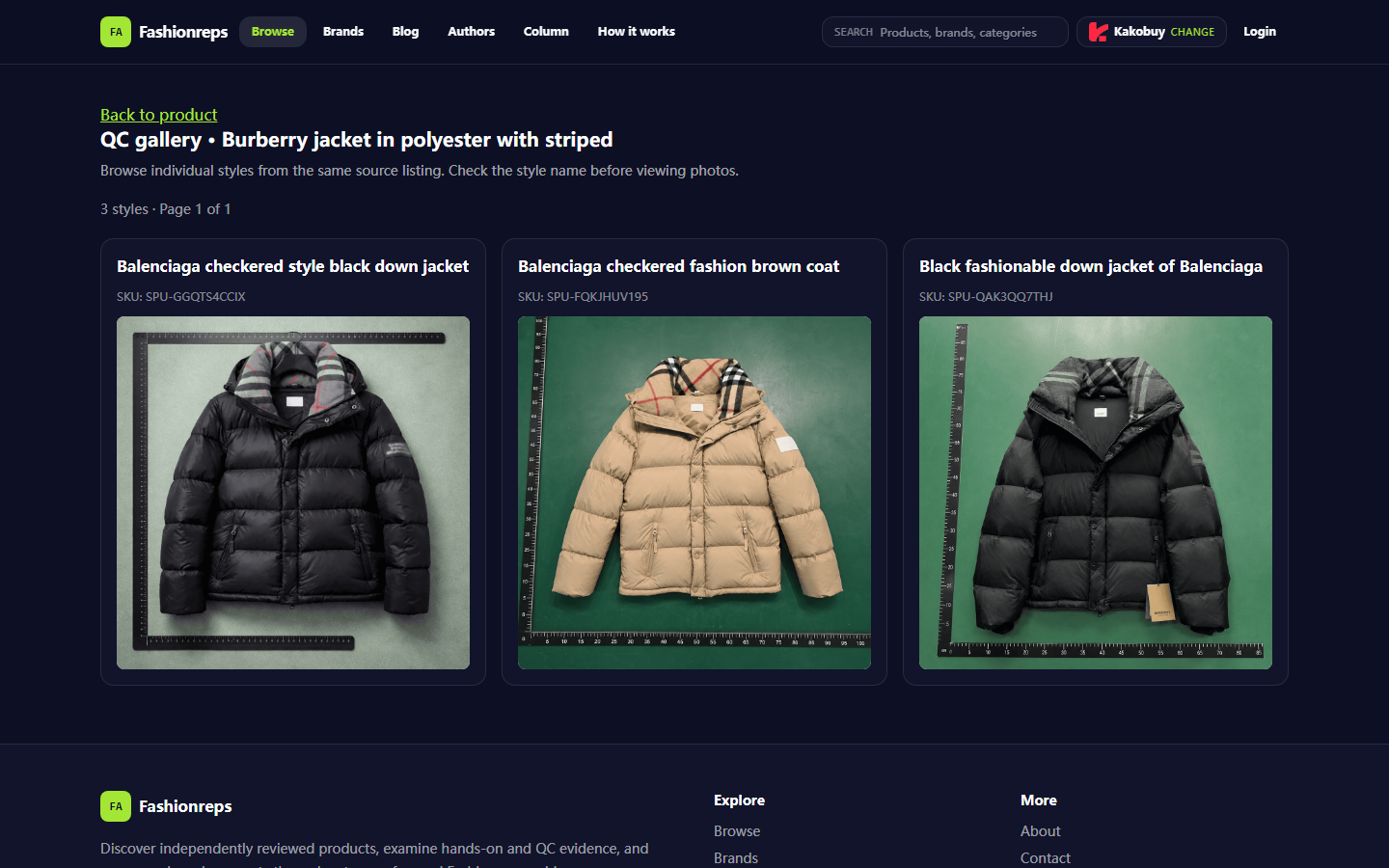
The reference page provided is a Burberry polyester striped jacket QC page on fashion-reps.net, not a scarf product page. The page title says "Burberry jacket in polyester with striped," and it lists other jacket styles from the same source. So this screenshot can't prove any scarf's size, color, material, or stock status.

For a scarf candidate page, at minimum record the following before buying:
- Does the product title clearly say scarf, not jacket, coat, or other accessory?
- Does the page show front, back, edges, and label areas?
- Does the color name match the main colors in the photos?
- Are both length and width provided, with clear units?
- Is the material specific, like polyester, wool, cashmere, or a blend, rather than just "premium fabric"?
- Does the page show a recognizable product code, seller info, or source note?
- Do the product photos belong to that scarf and not other items from the same brand or collection?
Currently, no valid scarf product page data is provided, so I can't fill in specific length, width, color, material, stock, price, or seller conclusions. The presence of "burberry" in the name also doesn't prove brand authorization, authenticity, or quality level.
How to Organize Scarf Length, Width, and Edge Details into a Checkable Record
Size checks should first see whether the page gives seller measurements, then use photos to help judge proportions. Photos can only help spot obvious stripes, checks, fringe, or binding; they can't replace a tape measure.
I recommend organizing the page info into this table:
| Check Item | Evidence the Page Should Provide | Current Judgment |
|---|---|---|
| Length | Clear value, units, and measurement method | No scarf product page provided, can't confirm |
| Width | Clear value, units, and measurement method | No scarf product page provided, can't confirm |
| Edge | Clear view of fringe, binding, or hem | Current reference image is a jacket, can't judge |
| Pattern Direction | Front and back detail photos | No scarf photos provided, can't confirm |
| Material | Specific fiber composition or page label | Current page only mentions polyester for a jacket, not applicable to a scarf |
If the seller only provides one distant shot, request a flat lay measurement photo, with length, width, and edges each in frame. If the scarf has obvious fringe, also confirm whether the measurements include the fringe. Different measuring methods can cause several centimeters of error, so don't write seller numbers as millimeter-precise facts.
Styling Judgment for Fall/Winter Coats, Knitwear, and Office Looks
Without confirming the actual scarf's size and color, you can only do conditional styling analysis, not claim it's already suitable for a certain way of wearing.
- If the length allows wrapping around the neck with drape left, it usually pairs better with a simple wool coat or short jacket.
- If the width is large, shawl-style use may be more natural, but you also need to check if the fabric slips easily.
- If the pattern has strong contrast, choose low-saturation solid colors for coats and knits to reduce pattern clash.
- If the scarf's main color is close to camel, black, gray, or beige, office styling is usually easier to control, but still depends on the actual color on the product page.
- If the page only shows part of the pattern, you can't judge the overall repeat, color block ratio, or front/back differences.
The key to fall/winter styling isn't just the brand name; it's also size, thickness, pattern density, and neckline type. A chunky scarf with a high-neck knit can make the neck look crowded; a thin scarf's relationship with a coat collar depends more on length and drape. 🧥
What Color and Pattern Conclusions the Page Photos Can Support
Page photos can support limited visual notes, like "the photo shows a light base with dark stripes," but they can't guarantee the screen color matches the real item. Lighting, white balance, compression, and display settings all affect color judgment.
In the current material, the only provided image is for a jacket QC page, so it shouldn't be used to infer a scarf's color, stripe width, fringe arrangement, or fabric texture. A safer approach is to ask the scarf candidate page for:
- A full flat lay in natural light
- A close-up of the pattern
- Photos of both ends and edge finishing
- A photo of the label or material tag
- A size reference photo with a ruler or common object
These photos can only improve page checking quality; they still can't prove feel, warmth, or long-term durability. If photos contradict the title, color name, or material description, pause first rather than making excuses for the seller. 📷
How Community Feedback Serves as Problem Leads, Not Quality Assurance
Currently, no complete community discussion samples are provided, so I can't cite specific user reviews, purchase experiences, or quality conclusions. Even if you find relevant discussions later, treat them as additional leads for checking, not as quality guarantees for the current item.
Valuable feedback usually helps spot these issues:
- Does the actual color often differ from the page photos?
- Are the seller's measurements significantly off?
- Do the edges fray easily?
- Does the material shown match the tag on the received item?
- Does packaging cause wrinkles or stains?
One positive review doesn't prove all batches are consistent, and one negative review doesn't automatically prove every item has the same problem. If discussions can't be fully read, replies are collapsed, or content is restricted, mark them as partially readable and don't claim a full read-through.
Unprovided Feel, Warmth, and Durability Can't Be Directly Inferred
Page photos and text can't reliably prove whether a scarf feels soft, scratches the skin, or is warm enough, nor can they prove shrinkage, pilling, fading, or loose threads after washing. The material name itself doesn't equal the actual fiber ratio or processing quality.
Therefore, you can't use conclusive descriptions like "soft," "thick," "warm," "durable," "high quality," or "authentic." If these factors decide the purchase, ask the seller for clear material composition, actual measurements, care instructions, and more detail photos. If they can't provide them, the purchase risk remains.
Also note that the fashion-reps page serves as product discovery and info organization; orders, payment, warehousing, shipping, tracking, customs, and after-sales are usually handled by the shopping agent and its website you choose. Before buying, check agent availability, destination country restrictions, tax liability, return policy, and shipping route separately. Don't treat product page info as complete order protection. 🚚
Final Action: Keep Candidate, Request More Proof, or Pause Purchase
Based on current info, I recommend pausing the direct purchase. Not because the product is proven poor, but because the existing reference image belongs to a Burberry jacket QC page and doesn't match the target scarf, so it can't support conclusions about the scarf's size, styling, color, material, or edge details.
Next, you can request the following additional proof from the seller or product page:
- A dedicated full photo of the scarf, not a screenshot from another clothing page
- Length, width, and measurement method
- Material composition and label photo
- Color and pattern details in natural light
- Photos of edges, fringe, back, and stitching
- A checkable product code, stock status, and current price
Only when these materials are consistent and the page info supports your use case is it appropriate to keep the candidate. If the seller can't provide key evidence, or if photos, title, and material description keep conflicting, it's not recommended to buy.
Currently, there are no calculable combined shipping savings or split costs, so I can't claim a certain shipping method saves money. For this candidate, the cost of asking for proof or pausing is delaying the order; the main risk of continuing is getting an item that doesn't match your expected size, color, material, or style. This approach suits buyers who value evidence checking and are willing to wait for more photos; it doesn't suit those who must order immediately based on existing page info.